
CASE STUDY: Reutech Radar Systems
FMCW Short Range Radar to Detect, Locate and Track Humans
2024/25
Reutech Radar Systems (RRS) has made a significant contribution to South Africa’s security landscape through its longstanding expertise in integrating sensor and surveillance systems at strategic national key points and commercial sites. Having identified a gap in the local market for a low-cost, short-range radar capable of detecting and tracking humans, particularly amid rising drone threats and illegal intrusions, RRS set out to develop a flexible, locally manufactured solution. Unlike costly international systems that offer limited local support and customisation, RRS aims to deliver a fully supported, adaptable radar product tailored to diverse operational environments.
The concept for this short-range radar system originated from RRS’s engineering internship programme, reflecting the company’s strong commitment to skills development and innovation. Over the past three years, a group of interns transformed the idea into a working prototype with validated cost-performance viability. Building on this momentum, RRS secured support from the Aerospace Industry Support Initiative AISI to industrialise the radar, advance its development, and complete product qualification, taking it from a successful prototype to a commercially viable solution.
The next phase of the project will focus on refining the system for low-volume production. Enhancements include improved target classification, camera integration, and the optimisation of the Human-Machine Interface HMI. Software and firmware updates will support a minimum viable product MVP, while the development of a manufacturable enclosure and a comprehensive data pack will streamline production readiness. These technical improvements are crucial for real-world testing and demonstrating the radar’s value proposition to potential customers in the security and safety markets.
The initiative has also generated significant economic and developmental impact. By engaging SMMEs such as RadarMarkers, TASSA, and Barracuda Holdings, RRS has promoted local content, job creation, and supply chain development. Most of the production activities have been executed within South Africa, supporting government objectives of inclusive industrial transformation. This collaborative model has allowed for agile prototyping and cost-effective manufacturing, while simultaneously fostering long-term relationships with local suppliers. RRS has committed to maintaining these partnerships beyond the life of the project.
Human capital development has been another major outcome of the project. Through hands-on participation, interns gained expertise in RF, digital, firmware, and mechanical design, with several transitioning into permanent roles at RRS. The radar system’s successful evolution from an internship concept into a market-ready technology showcases the value of structured support programmes like AISI. With improved functionality, local manufacturing readiness, and growing market interest, the FMCW SRR radar is well-positioned to serve South Africa’s security needs while reinforcing national technological capability and export potential.
Project Impact
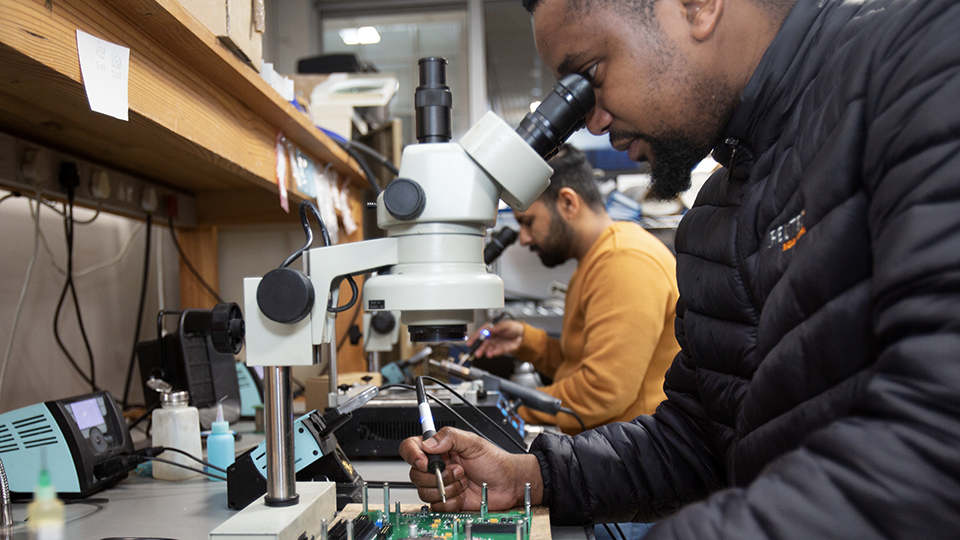
Isaac Mpheng, Graduate Designer: RF & Microwave, taking a closer look at a solder joint for any errors and for quality control on the processor PC board on the FMCW Short Range Radar.

