
CASE STUDY: LambdaG
Global Navigation Satellite System (GNSS) Antenna Development
2024/25
South Africa has a proud history in the space industry, with both government and private enterprises contributing to space engineering and mission support over the decades. Today, this tradition is being advanced in exciting new ways through the growth of “New Space” activities, which emphasise smaller, cost-effective satellites rather than the large and expensive spacecraft of the past. These new missions demand lightweight, energy-efficient, and affordable components, an area where South African innovators like LambdaG are now making their mark. Their work is helping position the country as a global competitor in the rapidly expanding market for small satellite technology.
LambdaG’s flagship initiative is the development of a space-qualified Global Navigation Satellite System (GNSS) antenna for spacecraft operating in Low Earth Orbit (LEO). These antennas are crucial because they provide navigation and timing data that ensure satellites can operate effectively in orbit. The company has designed both a single-band system, which complements existing GPS technology, and a wideband system capable of receiving all GNSS frequencies from L1 to L5. The wideband design incorporates a High Impedance Surface (HIS), an advanced metamaterial that improves performance by eliminating surface wave losses and reflecting electromagnetic waves without distortion. This innovation could significantly boost the competitiveness of locally produced antennas in international markets.
The project’s impact extends well beyond the technology itself. It has already created new employment opportunities and has nurtured advanced skills development within the company. For example, intern Patsa Khotso joined LambdaG and commenced doctoral research into compact antenna design using high impedance surfaces for small satellites. This not only enhances South Africa’s scarce skills base in advanced engineering but also builds a pipeline of specialised expertise for the country’s aerospace future.
Strategic collaboration has been key to the project’s success. LambdaG is working with several SMMEs including, Simutron, Opti-Num Solutions, PCBway, The Elite Group, METAL HEART, CHG Engineering CC, and ICAPE TRAX, ensuring that the benefits of the programme ripple across the local manufacturing and technology ecosystem. Academic support from the University of Pretoria and partnerships with the South African National Space Agency (SANSA), NewSpace Systems, Aeronet of Things, and Qfinsoft have further strengthened the initiative. Together, these collaborations highlight how government, academia, and industry can align to drive innovation in priority sectors.
Importantly, the project contributes directly to South Africa’s national strategies and programmes by replacing imported products with locally manufactured alternatives. It enhances industrial competitiveness, broadens export capability, and creates pathways for SMMEs to enter high-value global supply chains. By leveraging additive manufacturing (AM) to produce traditional waveguide antenna assemblies and mounting hardware, LambdaG is not only addressing domestic needs but also positioning itself as a supplier of advanced, lightweight antenna systems for international spacecraft and defence markets.
Looking ahead, LambdaG expects to reach the manufacturing stage by the first quarter of 2026, an important milestone in bringing its innovations to market. As Dr Vernon Davids, CEO of LambdaG, notes, this project exemplifies how small enterprises can transform South Africa’s role in the global aerospace industry: by delivering high-value, high-performance communication components that meet international demand while building local capacity and creating jobs. It is a vivid example of how “New Space” is not just about technology, but also about unlocking skills, opportunities, and industrial competitiveness for the nation.
Project Impact
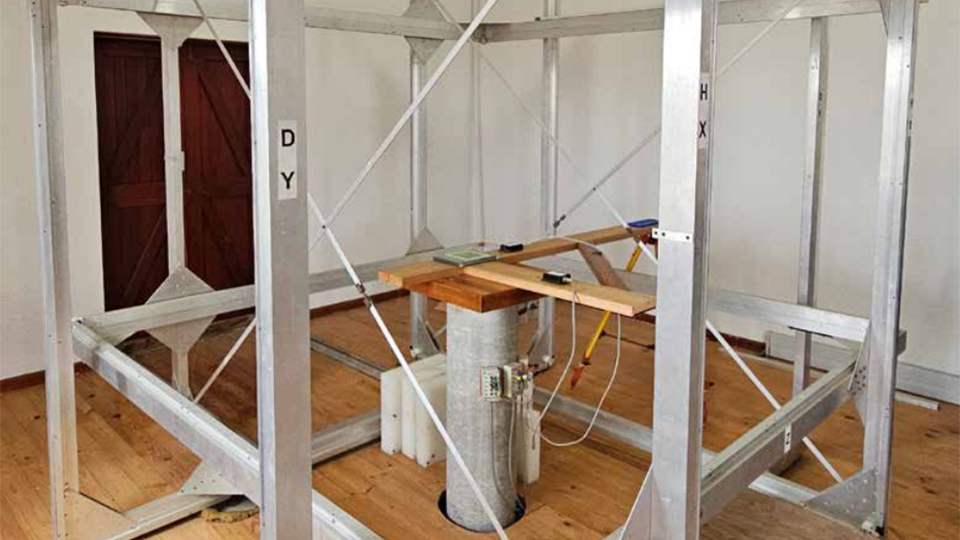
GNSS antenna dielectric material undergoing magnetic evaluation at SANSA’s tri-axial Helmholtz Coil.

