
CASE STUDY: Symbytech
Development of Manned Underwater Vehicle
2024/25
The Argonót manned underwater robotic vehicle is being developed by Symbytech to address the global challenge of biofouling, a problem that increases vessel drag, fuel consumption, greenhouse gas emissions, and the spread of invasive marine species. This has significant environmental and economic consequences, making the need for an effective, sustainable, and standards-compliant solution critical.
Argonót is designed as a multifunctional robotic device, which means that it adds far greater value than just hull cleaning. Whilst the current focus is on validating its ability as an early-stage robot, future plans are to continue enhancing its capabilities with AI components that allow Argonót to navigate autonomously while recognising features, structures, and organic materials such as marine growth. This will be achieved using Machine Learning and other software and hardware technologies.
These benefits position it as a pioneering South African technology with both national and international market potential. The AISI support for the project is focused on enhancing Argonót from a technology readiness level (TRL) 4 to TRL 6/7.
During the reporting period, the project has focused on stabilising the design, refining hardware and software systems, and conducting rigorous testing. A major milestone has been the development of the Argonót Smart Control (ASC), which coordinates propulsion, lighting, and mission payloads through a network of microcontrollers. Integrating in-house and partner-developed software with multiple hardware subsystems was complex, but successful system communication has resulted in improved stability and operational performance, bringing Argonót closer to operational readiness.
Challenges such as South Africa’s unstable power supply and electronic failure due to lower grade chips are being addressed.
“Hardware development has followed an iterative approach, with ‘controlled breaking’ phases used to identify weaknesses and guide design improvements,” comments Grant du Toit from Symbytech. “Through the implementation of adaptive solutions, the ultimate goal is more resilient electronics, simplified designs, and a workshop operation powered largely by renewable energy.”
By turning supply chain constraints into opportunities, the team has developed more efficient systems that outperform earlier prototypes. Partnerships with universities, engineering firms, and software providers have enriched the project, while manufacturing techniques such as computer numerical control (CNC) milling, laser cutting, and custom component fabrication have ensured precision and quality. The electronics have been designed with redundancy and adaptability in mind, meeting the demanding standards of global maritime authorities including BIMCO, Glofouling, IMO, and IACS.
Looking ahead, Symbytech is preparing to launch an extended pilot programme to demonstrate Argonót’s capabilities across sectors such as fisheries, shipping, oil and gas, and renewable energy. This is expected to strengthen South Africa’s maritime service offerings, create economic opportunities, and boost competitiveness in underwater maintenance and inspection services. With a dedicated push towards certification and commercial deployment, Argonót aims to deliver measurable environmental, operational, and economic impact both locally and globally.
What is biofouling?
Biofouling is the accumulation of aquatic organisms, such as algae, barnacles, mussels, and other marine life, on submerged surfaces like ship hulls, offshore structures, and underwater equipment. This growth increases drag, reduces vessel speed and fuel efficiency, raises greenhouse gas emissions, and can damage equipment. It also facilitates the spread of invasive species, disrupting ecosystems and causing significant environmental and economic impacts for industries reliant on marine operations.
Project Impact
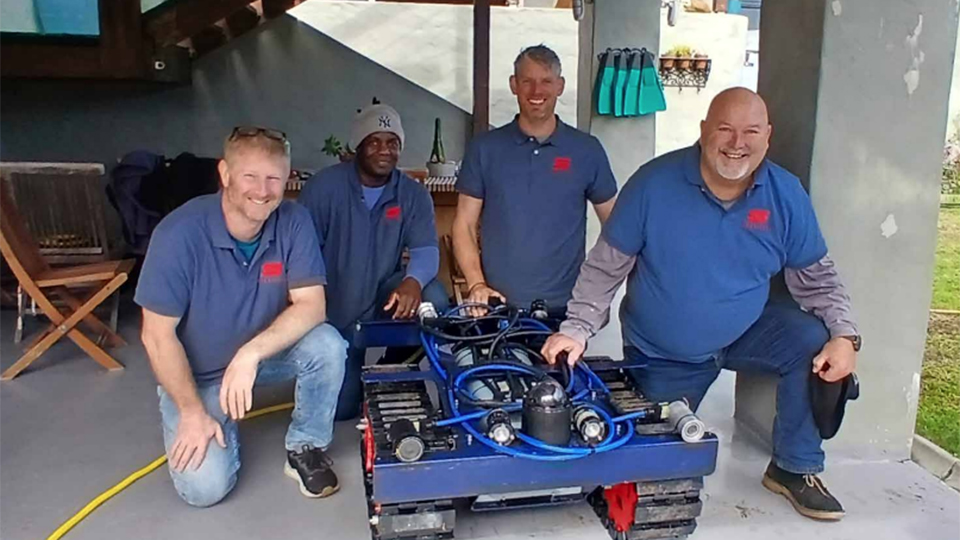
From left to right: Grant du Toit, Founder of SymbyTech, Joseph, general hand for the day, no affiliation with SymbyTech, Mathew Wagner, Mechanical Engineer, Technician and Operator, Eddie Noble, Business Advisor and Mentor. Eddie owns Noble Concentric Solutions and Odin Maritime.

