
CASE STUDY: HopYacht
Building Production Capacity for Export Sales
2024/25
The HopYacht production capacity expansion project is designed to address both current manufacturing bottlenecks and long-term market opportunities for the HopYacht 30, an innovative, all-electric catamaran targeting export markets. Its primary goal is to design and produce a new set of high-quality production moulds, especially for the cabin and hulls, that will ensure consistent build quality, reduce construction time by at least three weeks, and enable the annual output to grow significantly.
This shift is essential to meet the growing demand in Europe and North America, where the HopYacht 30’s eco-friendly features and unique demountable hull design position it in a niche market segment with limited competition.
In terms of impact, the project is expected to transform HopYacht’s operational capacity and strengthen South Africa’s marine manufacturing reputation globally. By replacing the deteriorating prototype cabin mould with a robust, two-part fibreglass mould, the company will drastically cut recurring repair time, improve surface finish quality, and extend the mould’s lifespan from fewer than 10 units to over 20. This not only boosts production efficiency but also enhances product quality and customer satisfaction, helping maintain a premium position in the export market.
From a skills development perspective, the project incorporates in-house training for the mould production team and internships for young talent, such as an intern from the Lawhill Maritime Centre. These opportunities ensure knowledge transfer in advanced composite mould-making, precision measurement, and computer aided design. This investment in human capital directly supports South Africa’s industrial growth agenda, particularly in fostering specialised marine industry skills that align with sustainable, electric-powered vessel manufacturing.
Progress to date has been substantial despite early challenges and the preliminary design phase is complete. The next phase will focus on completing the cabin mould, fast-tracking the simpler hull moulds to finish within the same period, and commencing the testing and validation stage. Once these milestones are achieved, HopYacht will be positioned to meet increased export demand efficiently, reduce per-unit production time and cost, and reinforce South Africa’s standing as a leader in innovative, sustainable marine manufacturing. This combination of technological upgrade, workforce development, and market expansion underscores the project’s strategic significance for both the company and the broader sector.
Project Impact
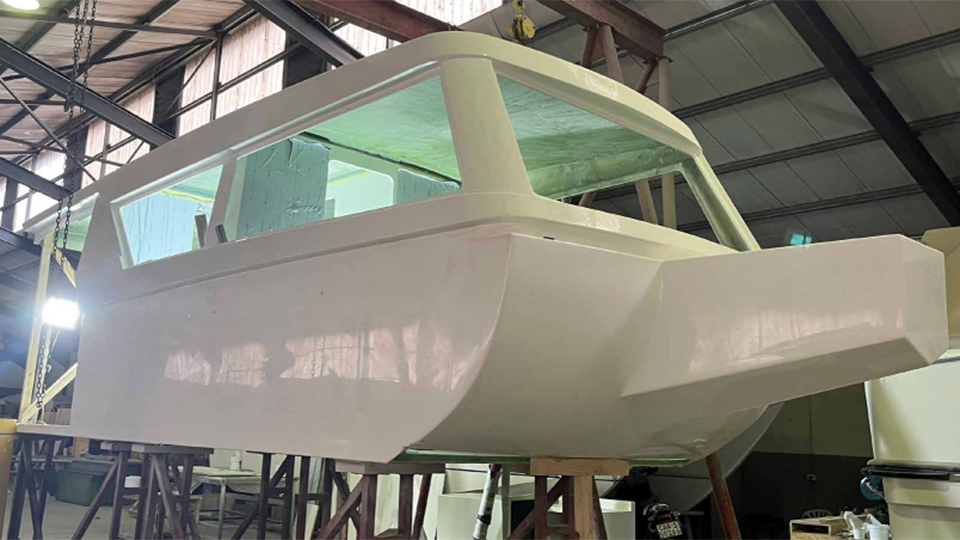
Front view of the first cabin produced from the mould

